
Paddlewheel aerator layout and dissolved oxygen in shrimp ponds: DO thresholds, aeration capacity, aerator placement and running schedule
Correct aerator layout keeps dissolved oxygen up and gathers waste into the siphon pit. DO thresholds, aerator capacity, bottom aeration and running schedule.

In this article
- How important is dissolved oxygen in a shrimp pond?
- Dissolved oxygen (DO) thresholds for shrimp ponds
- Why is oxygen lowest at dawn?
- Calculating aerator capacity from feed input and biomass
- Placing aerators to gather waste towards the pond centre
- Bottom aeration (bottom oxygen): a complement to paddlewheels
- Daily aerator running schedule
- Supporting Noben products
- References
- Frequently asked questions
How many aerators does a shrimp pond need, where should they go and when should they run? A correct shrimp pond aerator layout keeps dissolved oxygen (DO) sufficient for the shrimp, gathers waste into the siphon pit and saves electricity. This article covers how to calculate and lay out paddlewheel aerators and aeration from the start of the crop. If your shrimp are already surfacing and gasping, see the article on emergency treatment for shrimp surfacing due to low oxygen.
How important is dissolved oxygen in a shrimp pond?
Phytoplankton, bacteria and organic matter on the bottom consume oxygen just as the shrimp do. According to Professor Claude E. Boyd (Auburn University), prolonged low DO in ponds causes the stock to eat less, become more susceptible to disease and suffer higher mortality (Boyd, 2004).
- The more feed, the greater the oxygen demand. This is why Boyd (2014) calculates aeration capacity from the daily feed input. Overfeeding is a self-inflicted cause of oxygen deficiency.
- An oxygen-depleted bottom produces toxic gases. Ponds with good water circulation at the bottom are less prone to anaerobic conditions at the sediment–water interface than ponds with poor circulation (Boyd, 2006). Anaerobic conditions are what produce H₂S. See also nitrification and the toxic gases NH3 and NO2 in lined ponds.
- Thermal stratification leaves the bottom short of oxygen. During the day the surface water warms up and stratifies; DO near the bottom is often much lower than at the surface (Boyd, 2006).
Dissolved oxygen (DO) thresholds for shrimp ponds
| DO level | Meaning | Source |
|---|---|---|
| 3.5 mg/L or higher | Level specified for aquaculture in QCVN 02-19:2014/BNNPTNT | Cited from Can Tho University Journal of Science (2018) |
| Below 3–4 mg/L | Most fish and shrimp species become stressed | Boyd (2004) |
| Above 4 mg/L at night | Target DO for aerated warm-water ponds | Boyd (2014) |
| Above 6 mg/L | Recommended for biofloc whiteleg shrimp nursery ponds and tanks | Tran Ngoc Hai et al. (2020) |
DO that does not yet kill shrimp can still stress them and reduce feeding; do not wait until shrimp are surfacing before adding aeration.
Why is oxygen lowest at dawn?
During the day, phytoplankton photosynthesise and produce oxygen. At night photosynthesis stops but shrimp, phytoplankton and bacteria keep respiring, so in an unaerated pond DO falls steadily throughout the night. According to Boyd (2004), DO is usually lowest in the early morning; algae crashes and heavily overcast weather also cause episodes of low DO.
Excessively dense algal blooms, a bottom heavy with organic matter and high feeding rates all make night-time DO drop further.
That is why you need to measure DO at dawn (and also at night once shrimp are large) to know whether the aeration system is adequate. See how to measure and read shrimp pond water parameters.
Calculating aerator capacity from feed input and biomass
Two ways to estimate:
- From feed input (Boyd, 2014): about 1 HP of aeration for every 10 kg of feed/ha/day to keep night-time DO above 4 mg/L. Example: a pond fed 150 kg/ha/day at the end of the crop needs about 15 HP/ha, or about 18 HP/ha with a reserve.
- From shrimp production:
- The Can Tho University super-intensive biofloc whiteleg shrimp culture protocol (Tran Ngoc Hai et al., 2020): both paddlewheel aerators and oxygen blowers are needed, with a total capacity of about 1 HP per 400–600 kg of shrimp.
- Boyd (2004): each HP of aeration supports roughly 400 kg of additional production; for safety, install no less than 1.5 times the minimum.
Note: aerators typically have a standard aeration efficiency (SAE) of 1–2 kg oxygen/HP/hour, measured in clean, deoxygenated water. When running in a pond with DO of 3–4 mg/L, the actual oxygen transferred is only 40–50% of the manufacturer's figure (Boyd, 2004).
Hypothetical example to illustrate the calculation
This is a hypothetical example to illustrate the calculation, not measured data. A 1,000 m² (0.1 ha) lined pond, expected to harvest about 2,000 kg of shrimp at the end of the crop, with a peak feed input of about 30 kg/day.
- By feed: 30 kg/day on 0.1 ha is equivalent to 300 kg/ha/day → 30 HP/ha → about 3 HP for the pond; with a safety factor of 1.5 → about 4.5 HP.
- By biomass: 2,000 kg ÷ (400–600 kg/HP) → about 3.3–5 HP (including both paddlewheels and bottom oxygen).
There is no need to run full capacity from the start of the crop: Boyd (2014) advises increasing the number of aerators running in step with the feed input. See also costs and profit of a whiteleg shrimp crop in lined ponds.
Placing aerators to gather waste towards the pond centre
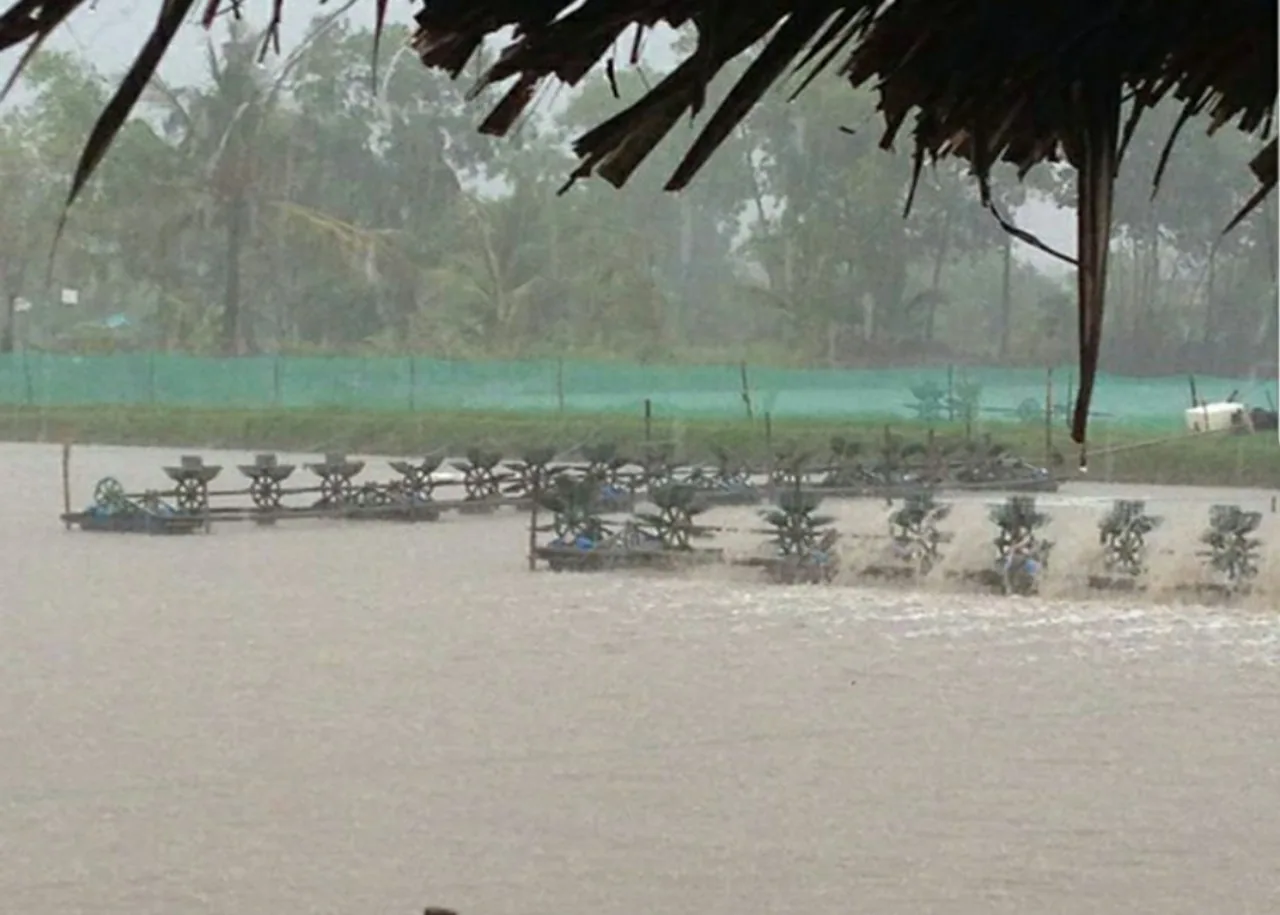
General principles from Boyd (2004, 2014):
- For shrimp ponds, creating a circular water current is a good layout.
- Rectangular ponds: direct the current along the length of the pond.
- In earthen ponds, shrimp farmers tend to place many small aerators fairly evenly over the pond surface so that settled waste is distributed more evenly. Lined ponds with a siphon pit have the opposite goal: gathering waste in one place.
- The current should not hit the bank head-on; the currents from different aerator units must not oppose and cancel each other out.
- Do not place aerators where the water is shallower than 0.75 m or right next to the bank.
For lined ponds and above-ground tanks with a central siphon pit (sump):
- Waste gathered in the sump is drained from the bottom or siphoned regularly and sent to a waste holding area (Tran Ngoc Hai et al., 2020).
- Place the aerator units in the same direction (all clockwise or all anticlockwise), set back from the bank, so the whole water body rotates. As the water rotates, sediment tends to accumulate in the central zone where the current is slowest, and is then discharged through the siphon pit.
- One high-tech farming area in Quang Ninh installs 3–5 aerator units per pond, depending on how well each unit gathers waste and its oxygen transfer efficiency (Agriculture and Environment Newspaper, 2023).
- Check: any spot on the bottom where sludge and slime remain indicates a weak current; adjust the direction or move the aerator unit.
See high-density whiteleg shrimp farming in lined ponds.
Bottom aeration (bottom oxygen): a complement to paddlewheels
Mixing by wind or mechanical devices helps break stratification and brings more oxygen down near the bottom (Boyd, 2006).
- The Can Tho University biofloc protocol requires strong aeration, supplying bottom oxygen evenly throughout the pond (Tran Ngoc Hai et al., 2020).
- The Quang Ninh farm spreads air diffuser grids evenly around the pond: 2 m²/grid in nursery ponds, 3 m²/grid in grow-out ponds, none in the sump area so as not to stir up the gathered waste (Agriculture and Environment, 2023).
- Cost note: Boyd (2006) states that air-lift devices use 3–5 times more energy than mechanical aerators to transfer the same amount of oxygen, so he regards them mainly as water-mixing devices. When investing in air blowers, farmers should factor in the electricity cost.
Daily aerator running schedule
| Time | Suggestion | Basis |
|---|---|---|
| Evening to dawn | Increase aeration, run at full capacity; this is when DO falls and reaches its lowest | Boyd (2004) |
| Mid-morning to afternoon | Some aerators can be switched off but keep the current going; vigorous splashing when the water is supersaturated loses oxygen to the air | Boyd (2004, 2006, 2014) |
| During feeding | Run paddlewheels and oxygen continuously | Tran Ngoc Hai et al. (2020) |
| Overcast weather, algae crash | Increase aeration during the day as well, monitor DO closely | Boyd (2004) |
High-density lined ponds should only reduce daytime aeration when bottom-layer DO remains stable. Boyd (2014) notes that automatic controllers switching aerators on and off based on DO sensors can save considerable electricity. Super-intensive shrimp farming requires 3-phase power and a backup generator (Tran Ngoc Hai et al., 2020).
Record the number of aerators running by shrimp age in the care schedule by days of culture. When DO stays low for a long time, refer to the solution for oxygen deficiency and stress shock.
Supporting Noben products
Products cannot replace paddlewheel aerators; use them for their intended purpose at the label dose, converted to your pond volume with the dose calculator:
- SUPER OXY 02: supplies oxygen quickly, for emergencies when shrimp surface due to low oxygen; 2–3 kg/1,000 m³ of water, spread evenly over the pond surface, with aerators running.
- OXY 99: supplies oxygen quickly during sudden oxygen deficiency; 2–3 kg/1,000 m³ of water, spread evenly over the pond surface, with aerators running.
- PROTICBEST: probiotic that cleans the bottom, cleans the water, removes liner slime, and breaks down organic waste and uneaten feed on the pond bottom.
- NB- BIOPOND: breaks down waste, organic sludge, uneaten feed and dead algae; cleans the bottom and the water.
References
- Aeration prevents low DO, aids feed efficiency, increases production – Global Seafood Alliance (C. E. Boyd), 2004
- Species, pond size define aeration approaches – Global Seafood Alliance (C. E. Boyd), 2014
- Mechanical water circulation aids pond water quality – Global Seafood Alliance (C. E. Boyd), 2006
- Super-intensive culture of whiteleg shrimp applying Biofloc technology (in Vietnamese) – Can Tho University, Agriculture Publishing House (Tran Ngoc Hai et al.), 2020
- A high-tech shrimp farm as beautiful as a resort (in Vietnamese) – Agriculture and Environment Newspaper, 2023
- Zoning of aquaculture water quality in Cau Hai Lagoon (citing QCVN 02-19:2014/BNNPTNT) (in Vietnamese) – Can Tho University Journal of Science, 2018
Frequently asked questions
What is the minimum dissolved oxygen in a shrimp pond?
QCVN 02-19:2014/BNNPTNT specifies 3.5 mg/L or higher. Boyd recommends keeping night-time DO above 4 mg/L; below 3–4 mg/L most shrimp and fish become stressed.
How many HP of aeration does a 1,000 m² shrimp pond need?
According to Boyd (2014), about 1 HP for every 10 kg of feed/ha/day; according to the Can Tho University protocol, about 1 HP per 400–600 kg of shrimp. Calculate from the peak feeding rate at the end of the crop and add a safety factor.
Why measure oxygen in the early morning?
DO is usually lowest in the early morning; measurements in the afternoon are usually high because of phytoplankton photosynthesis.
Should aerators be switched off during the day to save electricity?
They can be reduced from mid-morning to afternoon, but the current must be maintained to gather waste; high-density lined ponds should only reduce aeration when bottom DO remains stable.
How should aerators be placed so waste gathers in the siphon pit?
Place the aerator units in the same direction, set back from the bank, to create a rotating current across the whole pond; do not place bottom air diffusers in the sump area.