Shrimp farming in the rainy season: preventing pH shock, alkalinity drops and algae crashes, and what to do before, during and after heavy rain
Rainy season shrimp ponds risk pH shock, alkalinity and salinity drops, algae crashes and low bottom oxygen. How to manage ponds before, during and after heavy rain.

In this article
- How does heavy rain change a shrimp pond?
- The chain reaction: algae crash, oxygen depletion, toxic gases
- Water stratification: shrimp crowd into the zone with the least oxygen
- Falling salinity and alkalinity: shrimp struggle to harden their shells
- Acid sulphate runoff from pond dikes
- What to do before, during and after the rain
- Green algae when salinity drops low
- Supporting Noben products
- References
- Frequently asked questions
Shrimp farming in the rainy season is difficult because ponds change very quickly: after just one heavy downpour, pH drops, alkalinity and salinity fall, the algae crash, bottom oxygen is gradually depleted and toxic gases rise a few days later. This article explains why rain destabilises the pond and sets out what to do before, during and after the rain so that farmers can protect their shrimp proactively.
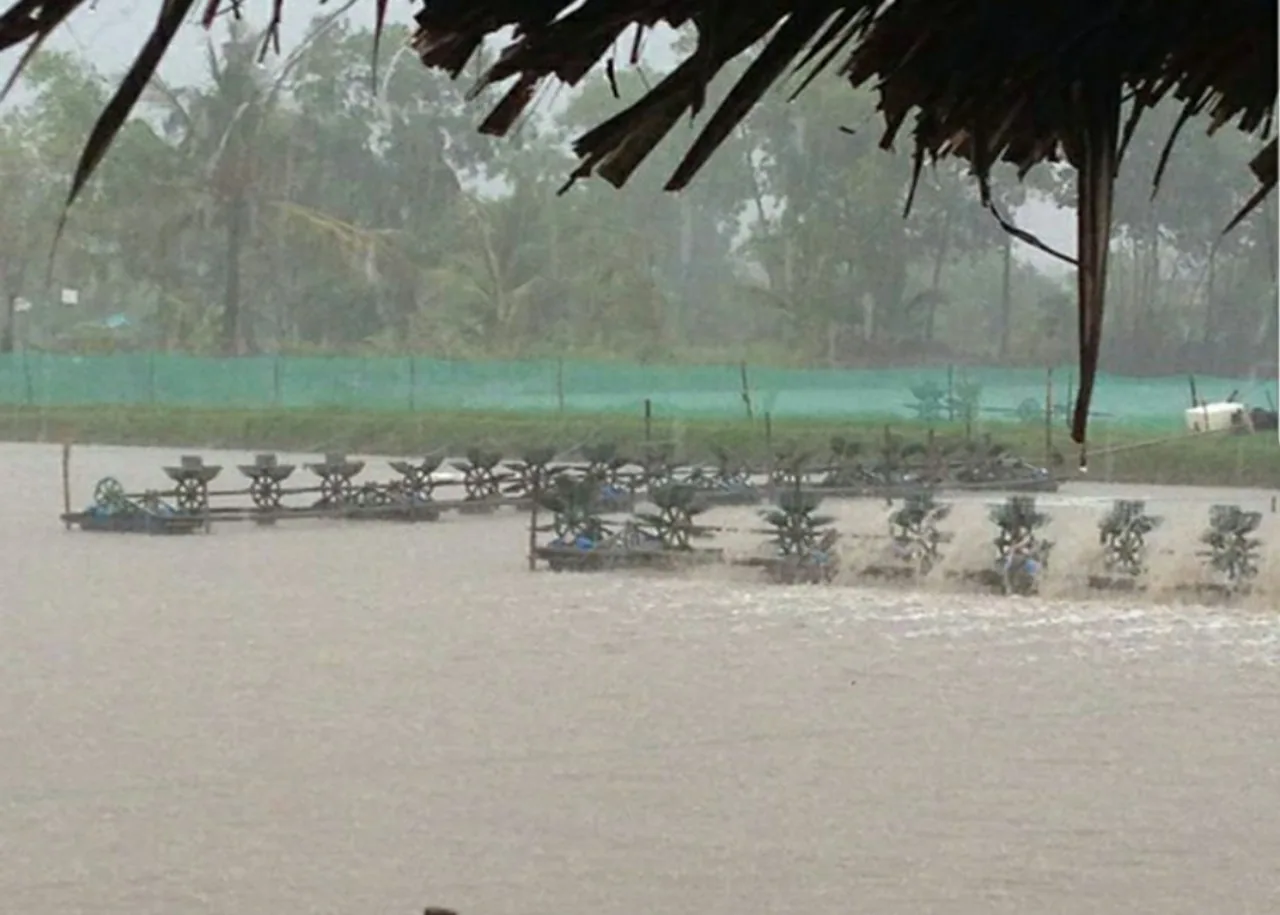
How does heavy rain change a shrimp pond?
Philip Buike (Ecuador's National Aquaculture Chamber, published by the Global Seafood Alliance, 2018) summarises the main changes after heavy rain:
| Parameter | Effect of heavy rain |
|---|---|
| Temperature | Usually falls by 3–5°C |
| pH | Initially falls to about 6.7, then may fall further |
| Salinity, hardness | Fall, depending on the amount of rain |
| Turbidity | Rises as clay washes in from the dikes |
| Dissolved oxygen | Rises at first, then falls sharply |
| H₂S, NH₃ | May rise after 2–3 days |
According to the same author, rainwater is slightly acidic (pH about 6.2–6.4) and 5–6°C colder than the air; heavy rain can lower pond pH by 0.3–1.5 units. He reports that 3–50% of the shrimp stock may die within 3–4 days after heavy rain, usually scattered mortality without clear warning signs.
Rain does not bring much oxygen into the pond: according to Professor Claude E. Boyd (Auburn University, 2020), 10 cm of rain adds only about 0.6 mg/L of oxygen to a pond 1.5 m deep, while several days of overcast weather lower night-time oxygen.
The chain reaction: algae crash, oxygen depletion, toxic gases
Rain is only the starting point. Buike (2018) describes the typical sequence of events:
- A sudden algae crash during or just after the rain, caused by the drop in pH, diluted minerals, turbid water and lack of sunlight.
- A surge in decomposing bacteria feeding on the dead algae settling on the bottom, which consume a great deal of oxygen.
- Oxygen falls continuously, even during the day, because the algae are no longer producing oxygen. Without aeration, oxygen can fall to dangerous levels (3 mg/L or lower) in less than half an hour.
- pH falls further because respiring bacteria release CO₂.
- The pond bottom turns anaerobic and produces H₂S. At low pH, H₂S becomes toxic to shrimp at concentrations they would normally tolerate. Vibrio readily becomes dominant.
See also how to recognise and handle this in the article algae crash in shrimp ponds and the solution page toxic gases on the pond bottom, slimy liners.
Water stratification: shrimp crowd into the zone with the least oxygen
Rainwater is lighter than brackish water, so it floats as a cold freshwater layer on the pond surface. The FAO technical manual on shrimp pond culture warns that this stratification can deplete oxygen in the saline layer below, especially in deep ponds with little wind; the water must be mixed after heavy rain.
Buike (2018) notes that when the water is stratified, shrimp crowd into the deeper, warmer and saltier areas, which are also where oxygen is lowest and H₂S highest; if full rations are still fed, uneaten feed makes the situation worse.
General approach: drain off part of the surface layer and run the paddlewheel aerators to mix the water column. Guidance from the Ca Mau Provincial Portal (2018) also recommends running aerators more during heavy rain to prevent thermal stratification, add oxygen and warm the water. See also paddlewheel aerator layout and dissolved oxygen.
Falling salinity and alkalinity: shrimp struggle to harden their shells
Rain dilutes the water, so salinity, hardness and alkalinity all fall. FAO gives a simple example: a pond only 10 cm deep that receives 10 cm of rain loses 50% of its salinity; a pond kept at 50 cm loses only about 17% salinity from the same rainfall. Keeping the water level deep enough therefore helps the pond "withstand" rain better. Ca Mau recommends an optimum water level of 1.2–1.5 m; when rainwater raises the level too high, drain off some of the surface water.
After moulting, shrimp must absorb calcium and magnesium from the water to harden their shells; when these are lacking, shrimp readily turn cannibalistic and die from opportunistic bacterial infections, often only seen a few weeks after the rain (Buike, 2018). Farmers should also read how to apply minerals for shrimp and the solution page soft shell, bent body, slow growth.
According to Ca Mau, suitable alkalinity is 100–150 mg/L for whiteleg shrimp and 85–130 mg/L for black tiger shrimp. When alkalinity is low after rain, dolomite can be soaked in fresh water for 24 hours and then broadcast at 8–10 pm, at a rate of 1.655 g of dolomite per 1 m³ of water to raise alkalinity by 1 mg/L. For example, a 3,000 m³ pond to be raised from 80 to 90 mg/L needs about 3,000 × 1.655 × 10 / 1,000 ≈ 50 kg. Raise alkalinity by only about 10 mg/L at a time so the shrimp are not shocked. The detailed calculation is in the article managing pH and alkalinity.
Acid sulphate runoff from pond dikes
In acid sulphate soil areas, rainwater running over the dikes carries acid and alum into the pond, lowering pH even further. FAO suggests digging a ditch along the dike berm to catch the acidic runoff and keep it out of the pond. Guidance from the Ha Tinh agriculture sector (2018) recommends spreading lime around the dikes or into the ditch around the dikes every 2 weeks, especially before thunderstorms. Detailed signs and treatment are in the article acid sulphate problems in shrimp ponds.
What to do before, during and after the rain
Before the rainy season and before the rain
- Dredge and widen drainage channels; repair and compact the dikes and reinforce areas prone to collapse (Buike, 2018).
- Place bags of lime (CaCO₃) along the pond dikes, about 500 kg/ha, so that the lime dissolves gradually when it rains, maintaining pH and hardness (Buike, 2018). Ca Mau advises spreading dry lime along the dikes when it rains at 10 kg/100 m².
- Make sure gates and pipes can drain off surface water.
- Check all paddlewheel aerators, generators and electrical panels before the rainy season.
- When the sky is overcast and rain is coming, reduce the feed ration, or stop feeding if the rain is close (Ca Mau, 2018).
During the rain
- Drain off surface water to remove the cold freshwater layer.
- Run all paddlewheel aerators, trying to keep oxygen above 4 mg/L (Buike, 2018).
- Measure pH and oxygen continuously; add lime (CaCO₃) if pH falls.
- Cut the feed ration sharply and keep adjusting it to temperature and oxygen. Buike explains that each 1°C drop in water temperature reduces shrimp feeding by about 10%, so rain that cools the water by 3–5°C reduces appetite by at least 30%.
After the rain stops
- Check the shrimp and water immediately: activity, colour, reflexes, gut, feed left on the feeding trays; measure pH, alkalinity, salinity and turbidity (Ca Mau, 2018).
- Raise pH gradually: Ca Mau advises dissolving CaCO₃ and broadcasting the clear supernatant evenly at 15–20 kg/100 m², running aerators to mix, and treating step by step until pH reaches 7.5 or above.
- Restore alkalinity and minerals according to the measured results, a little at a time.
- Resume feeding gradually: Ca Mau recommends resuming feeding only after the rain has stopped, at 30–50% less than normal; Buike advises increasing it step by step with temperature, and only once pH and oxygen are stable. See shrimp feed management.
- Re-estimate the shrimp population: because mortality is scattered, cast-net checks should be done daily for at least one week after the rain (Buike, 2018).
- Add vitamin C and minerals (potassium, sodium, magnesium) to the feed (Buike, 2018). See also vitamin C for shrimp.
- Maintain strong aeration until the algae have recovered and stabilised.
- Re-establish water colour once the water is less turbid, following the article how to build water colour.
Green algae when salinity drops low
Ca Mau reports that when salinity falls below 10 ppt, green algae grow readily and turn the water as green as pennywort juice, followed by an algae crash, strong pH swings, low oxygen in the early morning, and shrimp prone to fouling and black gill. See the solution page building water colour, managing algae.
Supporting Noben products
The following products provide support strictly within the uses stated on their labels; use them at label doses:
- VITA C (pond application): vitamin C applied directly to the pond to help prevent shock and reduce stress when the weather changes; 5 kg/3,000 m³ of water.
- DOWN MAX: reduces acidity and neutralises alum toxicity, removes alum from the bottom and water and alum adhering to shrimp legs and gills; during the culture cycle use 500 g/2,000 m³ of water.
- SUPER OXY 02: supplies oxygen quickly, for emergency use when shrimp surface due to lack of oxygen.
- AQUA YUCCA: rapidly absorbs toxic gases, for emergency use when shrimp surface.
- PREMIX MINERAL: supplies minerals for shell formation and moulting; supports shrimp with uneven moulting or prolonged soft shell.
Use the dose calculator to convert label doses to your pond volume, and see the care calendar by days of culture to know which stages need attention.
References
- Rainy season effects on shrimp grow-out ponds – Global Seafood Alliance (Philip Buike), 2018
- Effects of weather and climate on aquaculture – Global Seafood Alliance (C. E. Boyd), 2020
- Manual on pond culture of penaeid shrimp: Design criteria required by shrimp – FAO
- How to manage the environment of brackish-water shrimp ponds in the rainy season (in Vietnamese) – Ca Mau Provincial Portal, 2018
- Technical solutions for shrimp farming in prolonged hot weather and unusual thunderstorms (in Vietnamese) – Ha Tinh New Rural Development portal (from the Ha Tinh Department of Agriculture and Rural Development), 2018
Frequently asked questions
What should I do when pH drops after rain?
Drain off some surface water, run the aerators to mix the water, then broadcast settled lime (CaCO₃) water (Ca Mau: 15–20 kg/100 m²), treating step by step until pH reaches 7.5 or above.
Should shrimp be fed when it rains?
Feeding should be cut sharply or stopped when rain is approaching. Each 1°C drop in water temperature reduces shrimp feeding by about 10%. Resume feeding only after the rain stops, at 30–50% less than normal, then increase gradually.
Why do shrimp only die a few days after the rain?
Because the algae crash is followed by a rise in decomposing bacteria, bottom oxygen is gradually depleted, and H₂S and NH₃ rise after 2–3 days. Keep the aerators running and check the shrimp daily for at least one week.
What water level helps a pond withstand rain?
Ca Mau recommends 1.2–1.5 m; deeper ponds lose less salinity but aerators must be run to prevent stratification.