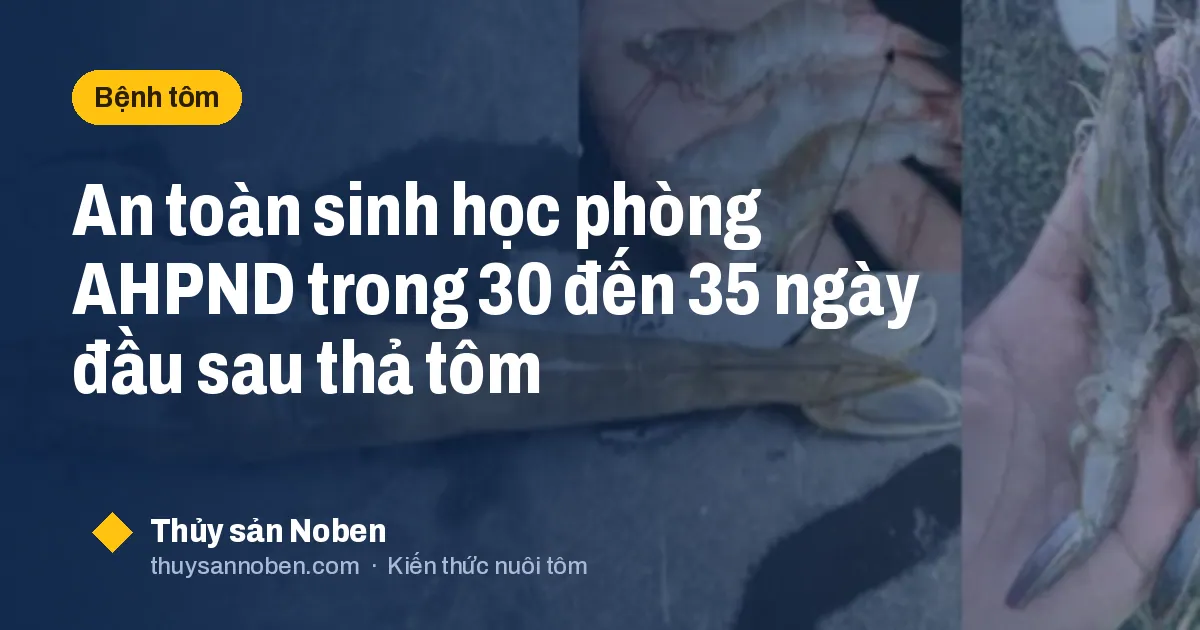
Biosecurity to prevent AHPND in the first 30–35 days after stocking shrimp
AHPND usually kills shrimp within 30–35 days of stocking. How to prepare water, choose and nurse postlarvae, feed and test for Vibrio to cut early deaths.
In this article
- Why are the first 30–35 days the danger period?
- How does the pathogen get into the pond?
- Before stocking: preparing water and pond
- Postlarvae selection and nursing: block the pathogen from the start
- During the first 35 days: feeding, pond bottom and oxygen
- Regular sampling for testing in the first 6 weeks
- Supporting Noben products
- References
- Frequently asked questions
Acute hepatopancreatic necrosis disease (AHPND, also known as early mortality syndrome, EMS) is the biggest concern in the early part of the crop. The article on acute hepatopancreatic necrosis disease (EMS) describes the signs of the disease. This article focuses on biosecurity during the first 30–35 days, the period when shrimp are most likely to die, following the recommendations of WOAH, FAO and the Vietnamese veterinary authority.
Why are the first 30–35 days the danger period?
According to the WOAH (World Organisation for Animal Health) Manual of Diagnostic Tests for Aquatic Animals (2023 edition), AHPND causes sudden, mass mortality, which can reach 100%, usually within 30–35 days after postlarvae or juveniles are stocked into ponds, and as early as day 10. Some outbreaks in the Philippines have still occurred later, between days 46 and 96.
The causative agent is strains of Vibrio parahaemolyticus carrying a plasmid of about 70 kbp that contains the pair of toxin genes pirA and pirB. Strains that lose this plasmid can no longer cause disease. This is why not every Vibrio causes AHPND, and testing must look for the specific virulence genes.
In Vietnam, guidance from the Department of Agriculture and Environment of Quang Nam (2025) notes that the disease occurs almost year-round but is concentrated from March to August, coinciding with the main stocking season; mortality can reach 90% within 3–5 days of the disease being detected.
WOAH also notes that there is currently no vaccine, no treatment and no immunostimulant proven effective against AHPND. Prevention through biosecurity is the most proactive approach.
How does the pathogen get into the pond?
An epidemiological study of more than 1,900 grow-out ponds in Vietnam under the FAO/MARD project (2013) concluded that the main sources of infection are likely infected postlarvae and contaminated water. The disease is transmitted orally and when healthy shrimp live together with diseased shrimp. WOAH also lists factors that make outbreaks more likely: overfeeding, poor-quality postlarvae, poor water quality, low-quality feed, and phytoplankton blooms followed by an algae crash.
Before stocking: preparing water and pond
The FAO/MARD study found that the following factors help reduce the risk of AHPND on farms:
- Reservoir/settling pond area over 30% of the culture area.
- Using chlorinated lime during pond preparation.
- Holding water in the settling pond for more than 35 days before pumping it into the grow-out pond.
- Using feeding trays to control feed quantity.
The good aquaculture practice (GAP) box in the same FAO report adds:
- Dry the pond for 2 weeks or more and move the sludge well away from the culture area.
- Filter intake water through double filter bags; keep the water level at the shallowest point at least 80 cm.
- Condition and stabilise the water for 10–15 days before stocking.
- Eliminate unwanted species such as trash fish, crustaceans and snails.
For high-density lined ponds, the principle is the same: have a settling pond, and treat and stabilise water before it is supplied. See also farming techniques for HDPE-lined ponds.
Postlarvae selection and nursing: block the pathogen from the start
- Only buy postlarvae with a quarantine certificate and a negative AHPND test result.
- Check the postlarvae: uniform size, good colour, strong swimming against the current (FAO).
- FAO recommends nursing postlarvae for 15–20 days on the farm and stocking into green water, avoiding stocking into water that is too clear.
- According to the Global Seafood Alliance (2016), the nursery area must be separate from the grow-out area, with strict biosecurity, and shrimp should not be kept in nursery tanks so long that the system's carrying capacity is exceeded.
- Stock all ponds in one area in a single batch, and avoid having newly stocked ponds next to ponds with larger, diseased shrimp.
During the first 35 days: feeding, pond bottom and oxygen
- Reduce feeding in the first month: the FAO/MARD study found that this helps reduce disease risk at pond level. Check feeding trays regularly and do not feed by guesswork.
- Moderate stocking density, ponds deeper than 1.8 m, and aeration were also risk-reducing factors in the same study.
- Siphon regularly to remove moulted shells and organic sludge. Shrimp shells contain chitin, which is a substrate for Vibrio growth (Global Seafood Alliance, 2016).
- Keep dissolved oxygen above 4 mg/L and alkalinity sufficient for stable pH. See managing pH and alkalinity in shrimp ponds.
- After each water disinfection, wait 2–3 days for chemical residues to dissipate before re-inoculating beneficial probiotics (never apply both on the same day); killing bacteria without replenishing probiotics can leave a gap for opportunistic Vibrio to grow.
- Do not use antibiotics for prevention.
Regular sampling for testing in the first 6 weeks
The Quang Nam guidance (2025) requires intensive and semi-intensive farms to sample shrimp, water and sludge every 2 weeks during the first 6 weeks after stocking to check total Vibrio counts and detect V. parahaemolyticus carrying the pathogenic genes.
- Sample at least 5 different locations in the pond and pool them into one sample; take water and sludge from the bottom layer.
- Keep chilled at 2–8°C and deliver to the laboratory as soon as possible, ideally within 24 hours.
- The laboratory uses the AP3 primer pair according to Department of Animal Health guidance to detect the AHPND virulence gene.
- If total Vibrio in water or sludge is 10³ CFU/mL or higher, adjust using probiotic products or approved disinfectant chemicals.
When bacteria carrying the AHPND gene are detected
- Shrimp not yet dying: apply integrated preventive measures, stabilise the environment, and prevent spread to other ponds.
- Shrimp already dying: do not treat on your own, do not discharge untreated wastewater, report to the veterinary authority and notify neighbouring farms. AHPND is on the list of diseases for which an outbreak must be officially declared.
Supporting Noben products
No product cures AHPND. The following products provide support according to the uses stated on their labels, at label doses:
- IODINE 99: kills harmful bacteria, fungi and protozoa in pond water.
- AQUA BAC: breaks down waste, uneaten feed and dead algae on the pond bottom, cleaning the bottom.
- LIVER MAX: supplies sorbitol and methionine in feed, supporting liver health and liver detoxification in shrimp.
- PROZYME: enzymes and probiotics that support digestion and feed absorption.
Farmers can use the dose calculator based on pond area and depth to work out product quantities according to the label.
References
- Chapter 2.2.1. Acute hepatopancreatic necrosis disease – WOAH Aquatic Manual, 2023
- Report of the FAO/MARD Technical Workshop on EMS/AHPNS of cultured shrimp (Fisheries and Aquaculture Report No. 1053) – FAO, 2013
- Guidance on disease prevention and control measures for some farmed aquatic species (Form No. 02: acute hepatopancreatic necrosis disease) (in Vietnamese) – Department of Agriculture and Environment of Quang Nam, 2025
- A holistic management approach to EMS – Global Seafood Alliance, 2016
Frequently asked questions
Does a high total Vibrio count mean the pond has AHPND?
Not necessarily. Only V. parahaemolyticus strains carrying the pirA and pirB toxin genes cause AHPND. A high total Vibrio count is an environmental warning sign; to know whether AHPND is present, PCR testing for the virulence genes is required.
Does farming at low salinity reduce AHPND?
WOAH notes that water with salinity below 20 ppt appears to reduce disease prevalence. However, low salinity does not replace water treatment, clean postlarvae and feed control.
Can frozen shrimp from a diseased pond transmit AHPND?
Experiments cited in the WOAH document show that AHPND was not transmitted from frozen samples of diseased shrimp. Even so, dead and diseased shrimp in the pond remain a source of infection and must be removed and disposed of according to regulations.
Does nursing shrimp before stocking help avoid early mortality?
FAO recommends nursing for 15–20 days so shrimp are stronger before going into the grow-out pond. The nursery area must be separate and have good biosecurity; otherwise it becomes a site of disease transmission.