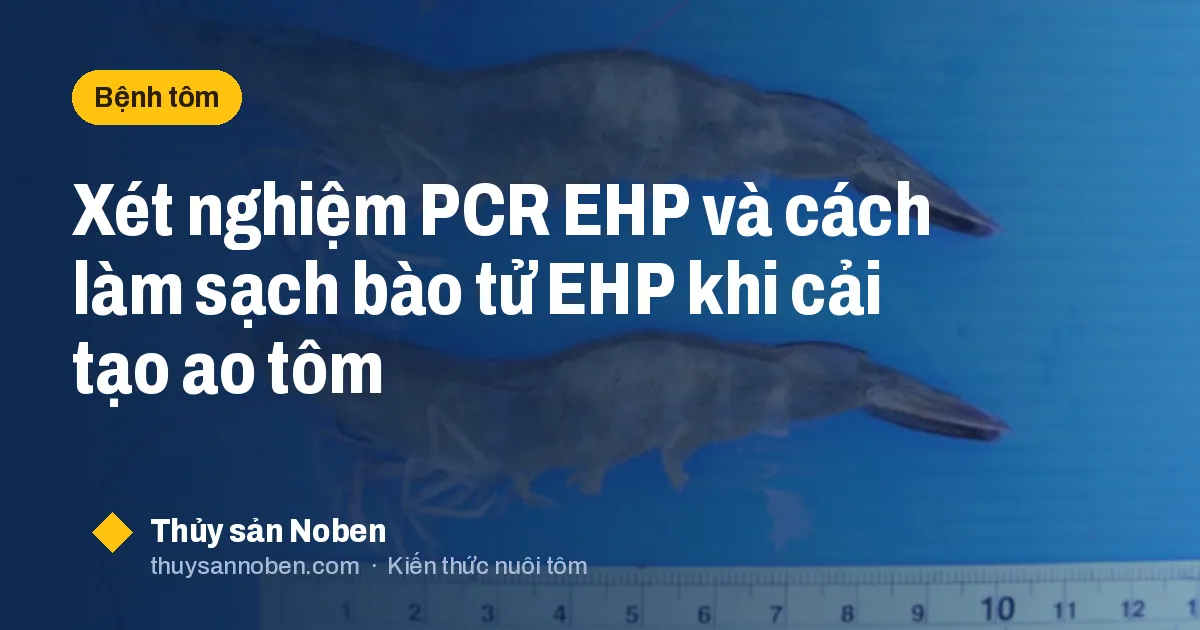
EHP PCR testing and clearing EHP spores during shrimp pond preparation
Which samples to send for accurate EHP PCR testing, why microscopy easily misses it, and how to use quicklime (CaO) and bottom drying to cut EHP spores before a new crop.
In this article
- Why testing is needed and it cannot be seen by eye
- How to collect samples for EHP PCR testing correctly
- Where do EHP spores persist?
- Preparing an earthen pond previously infected with EHP
- Preparing a lined pond previously infected with EHP
- Water treatment and biosecurity in the new crop
- Supporting Noben products
- References
- Frequently asked questions
The EHP microsporidian (Enterocytozoon hepatopenaei) does not cause mass mortality, but it makes shrimp grow slowly, causes size variation and prolongs the culture cycle. The article EHP microsporidian disease covered the signs and general prevention. This article goes deeper into the two things farmers most often get wrong: doing EHP PCR testing properly and preparing the pond to reduce EHP spores left over from the previous crop.
Why testing is needed and it cannot be seen by eye
EHP spores are very small, only about 1.1 × 0.7 micrometres, and sit inside hepatopancreatic cells. Infected shrimp show no typical gross lesions. According to the disease prevention guidance of the Department of Agriculture and Environment of Quang Nam (2025), EHP-infected ponds usually show uneven shrimp sizes after about 25 days from stocking, with growth reaching only 10–40% of that in uninfected ponds.
A Can Tho University survey in Kien Giang (2023) detected EHP infection from week 4 of culture, with infection rates ranging from 18–65%. After 12 weeks, uninfected shrimp averaged 13.6 cm and 20.2 g, while infected shrimp reached only 11.3 cm and 11.0 g.
Microscopy often gives unreliable results because the spores are so small, especially in whiteleg shrimp. Experts at NACA (2014) and Global Seafood Alliance (2015) both recommend prioritising PCR. In Vietnam, the Department of Animal Health has issued Standard 03:2016/TY-TS for diagnosing EHP by PCR, which is applied in veterinary diagnostic laboratories.
How to collect samples for EHP PCR testing correctly
Postlarvae samples before stocking
- Send a postlarvae sample that represents the whole batch. If a PL batch tests positive for EHP, do not stock it.
- If the hatchery has already extracted DNA from the postlarvae to test for acute hepatopancreatic necrosis disease (AHPND), the same DNA extract can be used to test for EHP (NACA, 2014).
- Ask the hatchery for the EHP test results of the broodstock and the fresh live feed. The Quang Nam guidance requires hatcheries to test to ensure postlarvae are free of EHP before sale.
Samples of shrimp in culture
- The best sample is the hepatopancreas. According to Global Seafood Alliance (2015), DNA extracted from hepatopancreas tissue gives the most reliable PCR results.
- Testing from faeces is more convenient but may give false negatives when shrimp are only lightly or recently infected.
- In ponds with size variation, sample both large and stunted shrimp for comparison.
Sludge, water and feed samples
Environmental samples can give false positives if the wrong method is used. The study by Jaroenlak et al. (PLoS ONE, 2016) showed that PCR based on the SSU rRNA gene can cross-react with microsporidian species closely related to EHP. The authors recommend using nested PCR targeting the SWP gene (spore wall protein) to screen faeces, feed and environmental samples, and re-checking earlier positive results from bottom sludge samples.
When sending samples, farmers should ask the laboratory which method it uses, especially for sludge and water samples.
Where do EHP spores persist?
EHP spores have thick walls and withstand many chemicals. According to a document from the National Agricultural Extension Centre (2015), the pathogen can survive treatment with 100 ppm chlorine. NACA (2014) also noted that chlorine, even at high concentrations, is not sufficient on its own to kill EHP spores. Spores are usually mixed into the bottom sludge, especially where organic matter accumulates.
Therefore, to reduce spores for the next crop, you must treat the pond bottom, not just the water.
Preparing an earthen pond previously infected with EHP
- Collect bottom sludge and waste and move it outside the farming area to dry; do not dump it into the supply canal.
- Dry the bottom until it cracks (for ponds without acid sulphate soil). The National Agricultural Extension Centre (2019) recommends drying the bottom of earthen ponds for at least 2–3 weeks.
- Apply quicklime (CaO) at a high rate. NACA recommends about 6 tonnes/ha, ploughed into the dry bottom layer to a depth of 10–12 cm, then moistening the bottom so the lime reacts. The bottom soil should reach pH 12 or higher for several days, then be left for about 1 week before drying again or filling with water. The pH then falls gradually on its own as the lime converts to CaCO₃.
- Or flood the pond and hold a high pH. Quang Nam guidance: spread CaO powder evenly over the bottom, fill with water and soak, maintaining a pH of about 11–12 for about 5 days before readjusting the pH according to the culture protocol.
- Check bottom pH with test strips or a pH pen during the treatment days, and add more lime wherever the pH has not risen.
The actual amount of lime depends on soil type, acidity and the amount of remaining sludge, so farmers should consult a technical officer. Quicklime releases a lot of heat on contact with water; wear goggles, gloves and a mask when spreading it.
Global Seafood Alliance experts note that proper treatment greatly reduces the number of spores but it is difficult to eliminate them 100%. The aim is to bring pathogen pressure down as low as possible.
Preparing a lined pond previously infected with EHP
- Drain completely, remove all sludge from the siphon pit and scrub the liner with fresh water.
- Dry the liner, then disinfect it with lime water or permitted chemicals (Quang Nam guidance).
- The National Agricultural Extension Centre's guidance for lined ponds: scrub, dry, treat with lime, rinse again, then treat with chlorine at a minimum of 30 ppm before starting the crop.
- Do not forget the inlet and outlet pipes, feeding chutes, feeding trays, nets and siphon pipes: these are places where sludge builds up over time.
Water treatment and biosecurity in the new crop
- Take in water through filter bags to keep out crustaceans, polychaete worms and other intermediate hosts. The Quang Nam guidance recommends disinfecting water in the settling/reservoir pond with chlorine at 15–30 ppm or an equivalent method.
- Do not use fresh live feed of unknown origin. Polychaete worms, clams, cockles, oysters and Artemia have all been recorded as possible carriers of EHP.
- Use separate equipment for each pond. Fence ponds with crab-exclusion netting and scare away birds.
- Do not thin out shrimp from a suspected infected pond into other ponds.
- Water from EHP-infected ponds must be treated with chlorine at 30 ppm and held for 7 days before discharge into the environment (Quang Nam guidance).
Farmers can record the pond preparation, testing and stocking milestones in the shrimp care calendar by days of culture so nothing is missed.
Supporting Noben products
There is currently no specific treatment for EHP, and no product can kill EHP spores already inside the shrimp hepatopancreas. The products below only provide support within the uses stated on their labels, at label doses:
- SUPER VIDAL: disinfects water in culture ponds and settling ponds before it is supplied to the culture pond.
- AQUA BAC: breaks down waste and organic debris, cleans the pond bottom during the crop and reduces sludge build-up.
- HEPALIVER FS: liver tonic, detoxifies the liver, strengthens liver function.
- BIOZYME: live enzymes that support digestion and help shrimp absorb feed better.
References
- Guidance on disease prevention and control measures for selected farmed aquatic species (Form 03: microsporidian disease) (in Vietnamese) – Department of Agriculture and Environment of Quang Nam, 2025
- Controlling microsporidian disease well for successful shrimp farming (in Vietnamese) – National Agricultural Extension Centre, 2015
- Solutions to prevent disease caused by the EHP microsporidian in brackish-water shrimp (in Vietnamese) – National Agricultural Extension Centre, 2019
- Survey of the presence of the EHP microsporidian in whiteleg shrimp farmed in Kien Giang (in Vietnamese) – Can Tho University Journal of Science, 2023
- Urgent appeal to control spread of the shrimp microsporidian parasite EHP – NACA, 2014
- Microsporidian impacts shrimp production – Global Seafood Alliance, 2015
- A nested PCR assay to avoid false positive detection of EHP in environmental samples – PLoS ONE (Jaroenlak et al.), 2016
Frequently asked questions
Should I send hepatopancreas or faeces for EHP PCR testing?
The hepatopancreas gives the most reliable results. Faeces are easier to collect but may give false negatives if the shrimp are lightly infected, so when in doubt, also send hepatopancreas samples.
Does a positive EHP result from bottom sludge mean spores are definitely still in the pond?
Not necessarily. Some older PCR protocols can cross-react with other microsporidians. Ask the laboratory whether it uses the SWP-PCR method or can confirm the result.
Can high-dose chlorine alone kill EHP spores?
You should not rely on chlorine alone. EHP spores tolerate high chlorine concentrations, so it must be combined with sludge removal, bottom drying and quicklime (CaO) to raise the bottom pH to 12 or higher.
How long should I wait before restocking a pond infected with EHP in the previous crop?
There is no fixed figure. Complete all the steps: remove sludge, dry the bottom, treat with lime and hold a high pH for several days, wait for the pH to return to normal, treat the water, and then stock only postlarvae that have tested PCR-negative for EHP.