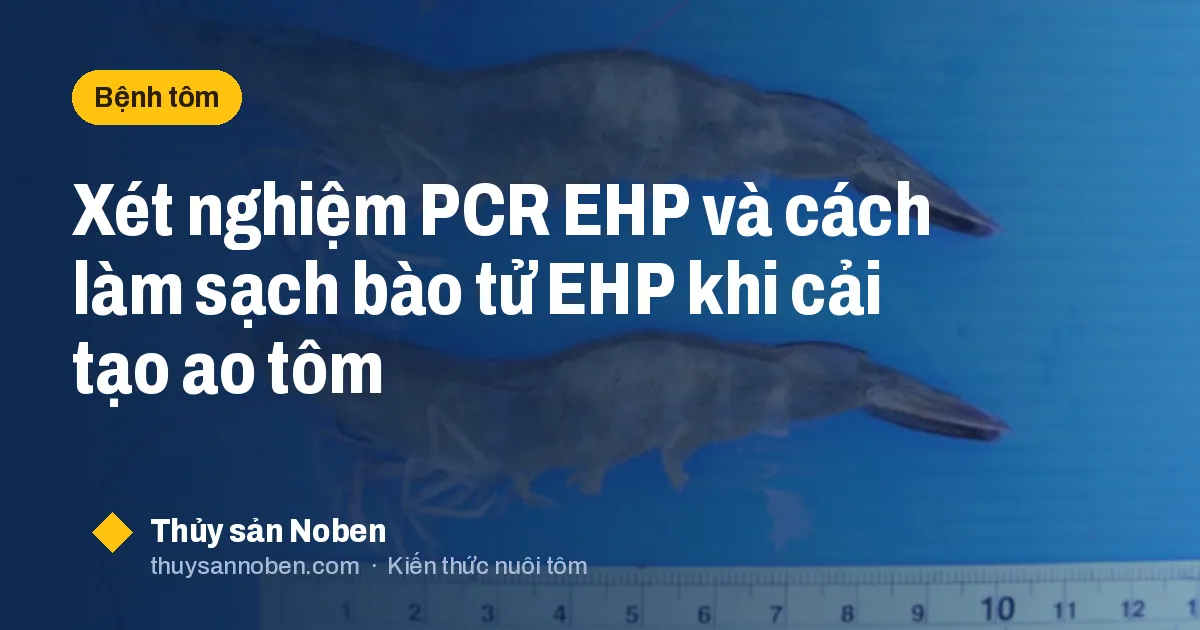
White feces syndrome (WFS): telling apart Vibrio, EHP, gregarine causes and how to test
White faecal strings floating in the pond may come from Vibrio, EHP, gregarines or sloughed hepatopancreatic microvilli. How to examine and test samples to find the cause.

In this article
On seeing white faecal strings floating on the pond surface, many farmers immediately reach for a familiar treatment protocol. But white feces syndrome (WFS) is not a disease caused by a single agent. Research shows it may be linked to Vibrio bacteria, the EHP microsporidian, gregarine parasites, or to damaged hepatopancreatic cells sloughing off. Correct treatment has to start with finding the right cause.
General management of a pond with white feces is covered in the article white feces disease in whiteleg shrimp. This article focuses on distinguishing the causes and how to test for them.
What does white feces syndrome look like?
- White to pale yellow faecal strings float on the water surface, collecting in pond corners, at the downwind end or on feeding trays.
- The shrimp gut is distended and contains white or yellow material; the hepatopancreas is pale and soft.
- Shrimp eat less, have soft shells, grow slowly and suffer prolonged scattered mortality.
An article on the Ca Mau Provincial Portal (2018) states that the disease is commonly seen from around 50 days of culture onwards.
The losses are significant: according to a survey in Thailand published in PLoS ONE (Sriurairatana et al., 2014), ponds with severe white feces had survival rates 20–30% lower, growth rates below 0.1 g/day compared with 0.2 g/day in normal ponds, and an FCR of 1.7–2.5 compared with 1.5 or lower.
Common causes
1. Aggregated transformed microvilli (ATM) from the hepatopancreas, easily mistaken for gregarines
In the past, the "vermiform bodies" in white feces were usually assumed to be gregarine parasites. The study by Sriurairatana et al. (2014) showed that most of them are in fact transformed microvilli that slough off the hepatopancreatic tubule cells and then aggregate (ATM). This is a sign of hepatopancreatic damage, not a living organism. In the 2009–2010 survey, 24 out of 25 ponds with white feces had shrimp carrying ATM.
How to tell them apart under the microscope, according to this study:
- ATM have no nucleus and no organelles; inside they consist of folded membranes.
- True gregarines are larger, stain more intensely and have a clear nucleus.
- Examine fresh mounts (squash preparations of hepatopancreas and gut) or stained smears; histological sections can often distort ATM.
The cause of ATM has still not been clearly identified.
2. Vibrio bacteria
The Ca Mau provincial article summarises many Vibrio species found at high densities in the hepatopancreas, gut and faeces of diseased shrimp, such as V. parahaemolyticus, V. alginolyticus and V. vulnificus. Pond conditions that commonly accompany white feces include: algae crash, high NH₃, blue-green algae blooms, high organic matter, high Vibrio counts in the water, alkalinity below 80 or above 200 mg/L, prolonged dissolved oxygen below 3 mg/L, and temperatures above 32°C.
3. EHP microsporidian combined with Vibrio
Guidance from the Department of Agriculture and Environment of Quang Nam (2025) notes that EHP is frequently detected in ponds already showing slow growth syndrome and white feces syndrome. A study at Can Tho University (2023) also reported that heavily EHP-infected shrimp can develop white feces and a discoloured hepatopancreas.
The study by Aranguren Caro et al. (PLoS ONE, 2021) was the first to reproduce white feces syndrome in the laboratory: only the group of shrimp infected with EHP and also challenged with a strain of V. parahaemolyticus developed white feces; groups infected with only one agent did not. This Vibrio strain does not carry the pirA/pirB toxin genes of acute hepatopancreatic necrosis disease (AHPND). Global Seafood Alliance (2022) summarised: white feces can be caused by a combination of several agents.
4. Environmental and feed factors
According to the Ca Mau provincial document, toxins from toxic gases (NH₃, H₂S), moulds in poorly stored feed, toxic algae and diatom shells can also damage the hepatopancreas and gut, opening the way for other agents.
Testing to find the right cause
Farmers should collect live shrimp that are showing signs, both healthy and weak individuals, send them to a laboratory and request the following checks:
- Fresh examination of the hepatopancreas and gut: look for true gregarines (with a nucleus) or ATM (without a nucleus); assess the degree of hepatopancreatic damage.
- EHP PCR on hepatopancreas samples: the Department of Animal Health has issued Standard 03:2016/TY-TS for diagnosing EHP by PCR. See also how to sample for EHP testing.
- Vibrio culture from the hepatopancreas, shrimp haemolymph, or water and sludge samples on TCBS medium. The Quang Nam guidance uses a total Vibrio count of 10³ CFU/mL or more in water or sludge as the threshold requiring corrective action.
- AHPND PCR (AP3 primer set) when shrimp are still small, die quickly and have an atrophied hepatopancreas, to rule out acute hepatopancreatic necrosis disease. See biosecurity to prevent AHPND.
- Measure water quality: NH₃, NO₂, alkalinity, dissolved oxygen, algal density; check that the feed is within its shelf life and free of mould.
Each cause, its own course of action
| Test result | Main course of action |
|---|---|
| High Vibrio, EHP negative | Reduce feed, improve the pond bottom and water, reduce organic matter, control Vibrio according to technical guidance |
| EHP positive | No specific treatment; keep shrimp feeding well and conditions stable, reduce Vibrio pressure, plan the harvest timing; carry out thorough pond preparation for the next crop |
| Many true gregarines | Treat according to the veterinary officer's guidance, combined with improving the pond bottom and water |
| Only ATM seen, poor water quality | Focus on improving the environment and feed, and reduce the factors that damage the hepatopancreas |
According to the Ca Mau provincial document, general prevention includes: feeding according to demand and water temperature (when water is above 32°C, do not increase feed based on the usual feeding tray checks), siphoning to remove waste, storing feed properly, controlling toxic algae and alkalinity, and keeping dissolved oxygen above 5 mg/L.
Supporting Noben products
The following products provide support strictly within the uses stated on their labels, at label doses. None of them cures EHP:
- MEGA CID: supports treatment of white feces disease, hepatopancreas problems and empty gut; lowers and stabilises the pH of the shrimp gut.
- BIOZYME: live enzymes that support digestion and help prevent gut diseases.
- HEPALIVER FS: liver tonic, detoxifies the liver, strengthens liver function.
- AQUA BAC: breaks down organic waste, cleans the pond bottom and reduces the nutrient supply for Vibrio.
References
- White feces syndrome of shrimp arises from transformation, sloughing and aggregation of hepatopancreatic microvilli into vermiform bodies superficially resembling gregarines – PLoS ONE (Sriurairatana et al.), 2014
- Experimental reproduction of White Feces Syndrome in whiteleg shrimp, Penaeus vannamei – PLoS ONE (Aranguren Caro et al.), 2021
- Study: White Feces Syndrome in shrimp can be caused by more than one pathogen – Global Seafood Alliance, 2022
- White feces disease in shrimp and how to prevent it (in Vietnamese) – Ca Mau Provincial Portal, 2018
- Guidance on disease prevention and control measures for selected farmed aquatic species (in Vietnamese) – Department of Agriculture and Environment of Quang Nam, 2025
- Survey of the presence of the EHP microsporidian in whiteleg shrimp farmed in Kien Giang (in Vietnamese) – Can Tho University Journal of Science, 2023
Frequently asked questions
If I see "worms" in white feces, does that mean my shrimp have gregarines?
Not necessarily. Many vermiform bodies are actually sloughed hepatopancreatic microvilli that have aggregated (ATM). True gregarines have a clear nucleus under the microscope; ATM have no nucleus.
Is white feces always caused by EHP?
No. EHP is common in ponds with white feces, but the 2021 study showed that Vibrio bacteria are also needed for white feces to appear. Vibrio, poor water quality and poor feed are also common causes.
What samples should I send when a pond has white feces?
Send live shrimp that are showing signs, together with water and bottom sludge samples. Request fresh examination of the hepatopancreas, EHP PCR, a Vibrio count, and AHPND PCR if the shrimp are still small and dying quickly.
Can white feces come back after the shrimp have recovered?
It can recur if the root cause is still there, such as an EHP-infected pond, a dirty bottom or high Vibrio. That is why testing is needed to treat the root cause rather than just the symptoms.